The Eastern Habitat Joint Venture

Partners conserving habitat for migratory birds and people
The EHJV’s success is a result of numerous partnerships among governments, non-governmental organizations and the private sector and landowners working together across the landscape to implement science-based conservation projects. Birds Canada, Ducks Unlimited Canada, the Nature Conservancy of Canada and Wildlife Habitat Canada are the main non-governmental organizations. In addition, approximately 7,000 volunteer landowners have helped the EHJV achieve its goals.
Guided by the North American Waterfowl Management Plan, EHJV partners relies on sound science and a collaborative approach to conserve important bird habitats through habitat retention and restoration.
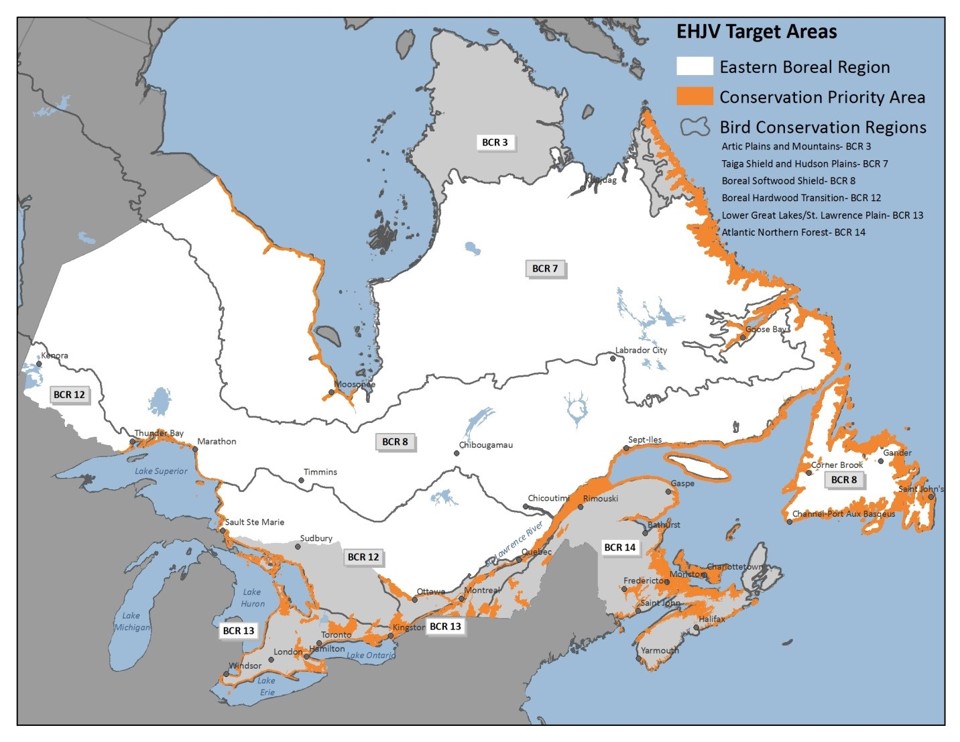
One of the ways EHJV partners protect wetland and associated upland habitats is through the protection of functional waterfowl habitat and the protection of important habitat for other bird species through habitat retention (or securement) activities. Habitat retention includes:
EHJV partners implement numerous restoration techniques to conserve and improve wetland and upland habitat functions and habitat conditions. This may include using a range of engineering techniques (e.g., berm construction, water-control structures) and, helping to control invasive species (e.g., Phragmites, water chestnut).
Some EHJV partners also work with farmers to modify common agricultural practices to benefit the producer and the environment. This can be accomplished by allowing vegetation re-growth and planting native trees and shrubs on marginal agricultural lands to provide upland nesting cover and increase habitat diversity.
The EHJV science program focuses on research, evaluation and monitoring programs, such as the Marsh Monitoring program. The Joint Venture continually works to improve the impact of investments on conservation actions. As with all EHJV efforts, sound science and a partnership approach are at the core of the planning, implementation and evaluation of all science activities.
EHJV partners encourage governments of all levels to support conservation and protect wetlands. Policy activities are non-confrontational and informed by science. For example, EHJV partners facilitate bird habitat conservation initiatives, programs, policies and legislation. The EHJV partners work within existing policy frameworks to promote beneficial policies and legislation that support waterfowl and wetland habitat, as well as habitat for all birds. They also encourage sustainable land-use practices by promoting science-based rationales to support proposed regulatory and legislative changes. Policy efforts, if highly focused and outcome-oriented, have great potential to impact land-management practices across the landscape for the benefit of wildlife and communities.